Compatibility and modules
ActionFlow 2 is designed as a visual authoring layer for Game Creator 2. It edits the real Game Creator components, lists, properties, and ScriptableObject assets already used by a project; it does not introduce a second runtime graph. The graph exposes their branching hierarchy while Game Creator data remains authoritative.
Unity and Game Creator versions
ActionFlow 2 uses the appropriate Unity object and scene identity APIs for each supported editor version. Current validation covers:
| Unity Editor | Game Creator 2 Core | Source selection |
|---|---|---|
| 6000.3.22f1 | 2.19.61 | Official packages compatible with Unity 6.3 |
| 6000.6.0f1 | 2.19.61 | Updated official packages compatible with Unity 6.6 |
Earlier validation covered Unity 6000.4.12f1/Core 2.18.60 and 6000.5.8f1/the revised official Core 2.19.61 upload. Future Unity or Game Creator updates require validation; the same visible package version can contain different vendor source uploads.
Install official Core and module releases compatible with your chosen Unity version. ActionFlow no longer migrates older vendor sources to newer Unity APIs. Its separate exact-source serialization fix still prevents no-op Inspector refreshes from dirtying scenes. Graph data, Undo/Redo, and prefab handling are unchanged by removal of the migration tools.
See Unity and Game Creator compatibility before upgrading. Maintain separate Unity 6.3 and 6.6 project copies with the appropriate vendor packages in each.
Game Creator 2 modules
ActionFlow 2 automatically integrates compatible modules installed against a supported Game Creator 2 Core source lane.
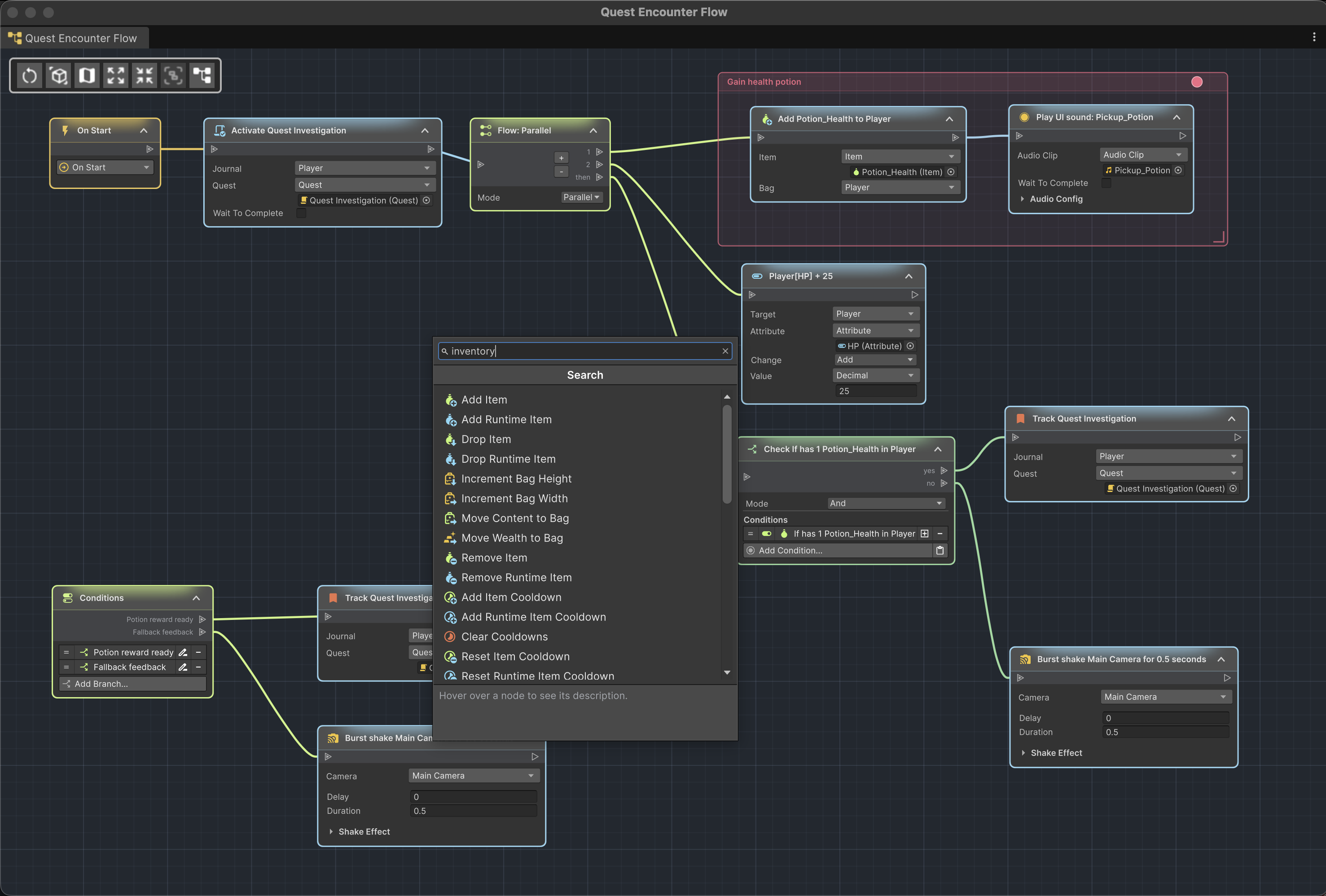
After Unity compiles, ActionFlow 2 discovers creatable Game Creator Events and Instructions from the installed assemblies. Module-provided entries appear in the normal node picker with their original categories and serialized fields. There is no separate ActionFlow integration package to install per module.
Reusable ActionFlow assets also discover compatible Game Creator property providers during compilation. Supported module value types become available as typed parameters and call-site arguments.
What automatic module support means
Events and Instructions built on Game Creator's standard APIs are exposed automatically. Parameter support applies to compatible public Game Creator property-provider types. A module can contain other editor tools or custom data that do not represent graph nodes or parameters. A future source revision may still be discoverable, but remains outside verified compatibility until it has been tested.
When adding, removing, or updating a module, let Unity finish recompiling and then reopen the graph or node picker.
Supported authoring targets
| Target | Authoring support | Runtime observation |
|---|---|---|
| Scene GameObject with Trigger, Actions, Conditions, or compatible Story Engine Rule | Graph structure, fields, layout, Undo/Redo | Yes |
| Prefab asset | Graph structure, fields, layout, Undo/Redo | When executed by an instance |
| Prefab instance, including variants and nested prefabs | Graph editing with Unity prefab overrides and source navigation | Yes |
| Instruction Asset | Rooted reusable graph and typed parameters | Yes |
| Branch Asset | Rooted reusable branch graph and typed parameters | Yes |
| Condition Asset | Focused Inspector and typed parameters | Through its callers |
| Compatible LogicBlock Block asset | Unified overview and list graphs | Yes |
Select a target name to open its authoring workflow. Every target continues to use its ordinary Unity and Game Creator data; ActionFlow 2 changes how that data is presented and edited, not where its runtime behavior lives.
Optional packages
Story Engine
When a compatible Story Engine version is installed, ActionFlow discovers its standalone Rule components without a compile-time dependency. A Rule root edits its title, Category, Priority, and embedded criteria and owns the connected visualization of its embedded instruction list. The node picker can create Rule components and exposes their rename pencil immediately. Rule roots delete like Trigger roots; a connected instruction chain remains under an Actions component. Rule copying remains protected, and Play Mode highlighting follows the executing Rule and its instruction chain.
LogicBlock
LogicBlock is optional. When a compatible version is present, ActionFlow 2 detects it and enables Block-asset editing, usage search, and runtime tracking. An unknown schema is rejected without modifying the asset.
NodeFlow
NodeFlow is not required. ActionFlow 2 provides its own graph authoring surface.
Custom Game Creator extensions
Custom Events and Instructions that follow Game Creator's standard creatable type patterns are discovered in the same way as module content. Compatible property-provider wrappers can also participate in ActionFlow asset parameter generation.
If custom content does not appear:
- resolve all compilation errors;
- confirm the type is concrete, public where required, and visible to Game Creator's own menus;
- reopen the picker after compilation;
- check the Console for an ActionFlow discovery or generation diagnostic.
Edit Mode and Play Mode
Structural authoring is supported in stable Edit Mode. ActionFlow 2 locks structural changes while Unity is playing or transitioning into or out of Play Mode.
In Play Mode:
- component graphs expose supported runtime value testing and restore their authoring state when Play Mode ends;
- ActionFlow and LogicBlock asset structures remain locked;
- ordinary asset value edits follow Unity's persistent asset behavior;
- open graphs can highlight component, asset-call, and LogicBlock execution.
Invoking authoring Undo while playing exits Play Mode before restoring the authoring state, preventing a runtime object from becoming the source of a structural edit.
Data ownership
Game Creator components and ScriptableObjects remain authoritative. Layout and view metadata are stored alongside or in relation to those targets, but the runtime behavior remains Game Creator data. This preserves normal Unity serialization, prefab overrides, version-control diffs, and project references.